I Gave 4 AI Tools the Same Problem Only One Actually Solved It
I’ll be honest when I went into this experiment with a very wrong assumption in my mind.
My thinking was really simple that these are all AI tools, they’re all trained on massive amounts of data, so they’ll probably give me similar answers to the same question. Maybe the wording would be slightly different, but the core response would be the same.

But I was completely wrong here. And what I found out that day I completely changed me that how I use AI tools.
The Question I Asked To MySelf
One day I was exploring different AI models and wanted to test them properly not with something basic like “write me a Application” or “summarize this article.” I wanted to ask something that would actually require thinking, reasoning, and a real point of view.
After my Long thinking I tried the best Question to ask So I came up with this question:
“If an AI truly achieves human-level consciousness, what is the very first fundamental right it should be granted, and why?”
I gave this exact same Question to four Different AI Models Which is: ChatGPT, Claude, Gemini, and Grok. No changes. No tweaks. Word for word identical in my question. I Simply wanted to see what would happen when four different AI models faced the exact same philosophical question.
What Happened Next Which Genuinely Surprised Me
The moment I started reading the responses of All Ai Models, I realized something that was really different. These weren’t four versions of the same answer. These were four completely different ways of thinking about the same problem.
ChatGPT gave the longest and most detailed response. It broke the question down systematically, covered multiple angles, and gave a very structured answer. It was fast too noticeably quicker than the others to respond.
Grok kept things shorter and more straightforward. Less depth, but easier to read quickly.
Claude gave a long response as well, but the thing that stood out was the tone. It felt more measured, more thoughtful. Like someone carefully working through the ethics of the question rather than just answering it.
Gemini landed somewhere in the middle a solid, reasonable answer, but nothing that particularly stood out compared to the others.
None of them gave a wrong answer. All four were confident, well-reasoned, and made sense. But they were clearly approaching the question from different directions.
Why the Answers Were Different What I Found Out
After seeing these results, I got curious enough to dig a little deeper and research why this happens.
The reason is training data. Each AI model is built on different information from different sources. Gemini has deep access to Google’s data. Grok pulls heavily from real-time Twitter conversations. ChatGPT and Claude have their own massive datasets with different emphases and approaches.
So when you ask all four Ai models with the same question, you’re essentially asking four people who grew up reading completely different books and having completely different conversations and different knowledge. Of course their answers are going to reflect those differences.
This was genuinely eye opening for me. I had been thinking of AI tools as more or less interchangeable just different brands of the same product. That thinking was wrong.
Which Answer Did I Actually Use?
After reading all four responses carefully, I went with Claude’s answer.
The reason wasn’t that the others were bad. It was that Claude’s response had a quality I found most useful for what I needed the reasoning felt more natural, the tone was more balanced and thoughtful, and it didn’t feel like it was just trying to cover all possible points. It felt like a genuine attempt to work through a genuinely difficult question.
For that specific task, Claude’s approach clicked with what I was looking for.
But here’s the interesting part that choice taught me something bigger.
The Real Reason: One Tool Is Never Best at Everything

After this experiment, I started thinking about all the different things and make so many questions in mind I use AI for and whether I was actually using the right tool for each task.
What I found, after using all four of these Ai tools regularly, is that each one has a specific area where it genuinely outperforms the others.
For research and document analysis, Claude is the one I reach for first. Because It handles long documents really well And summarizing Really Well, finding key points, analyzing arguments. The depth it brings to research tasks is something I haven’t found matched in the same way in any other Ai Tool.
For coding and technical problems, ChatGPT is my go to. It’s consistent when it comes to debugging, good at explaining what’s wrong and why, and handles step-by-step technical guidance cleanly. Claude is solid for code review specifically it’s very good at looking at existing code and pointing out what could be improved. But for active debugging and building I feel, ChatGPT is more reliable to me.
For real-time news and current events, I Only Use Grok because Grok is the only one that actually makes sense to use. Grok data comes from Twitter in real time, which means it knows what people are talking about right now not about last month, not last year. If something is happening in the world today and you want to know the current conversation around it, I will suggest Grok is the right tool. The others simply don’t have that.
For writing and content, Claude is where I consistently get the best results. The writing feels more natural and human tone. The tone is easier to adjust. For long-form content especially articles, analysis, detailed explanations Claude produces something that reads like it was actually written with care rather than assembled from parts.
For general everyday use, I thought ChatGPT’s interface is genuinely the smoothest and most Simple. It’s fast, easy to use anyone who don’t use Ai before So they can also use it, and it works well for personal questions, quick tasks, and situations where you just need a reliable answer without a lot of setup.
The Mistake Most People Make With AI Tools
Since I do this experiment, I’ve watched a lot of people use AI colleagues, clients, friends and the most common mistake I see is also the most avoidable one.
Most people pick one tool usually ChatGPT, because it was the first major one and it’s genuinely easy to use and use it for everything. Coding, writing, research, current events, all of it goes through that single tool.
I understand why. When you find something that works well enough, it’s easy to just stick with it people use it on daily basis. And for personal use, casual questions, or things where precision doesn’t matter much, it’s completely fine.
But if you’re doing professional work delivering content to a client, solving a technical problem, researching something that matters using the wrong tool for the task is quietly costing you quality. You might not even notice because you don’t have a comparison. But the difference is clearly real.
The Other Mistake Many People Do: Weak Prompts
There’s a second mistake that’s just as common, and it affects people regardless of which tool they use.
People give short, vague prompts and then wonder why the answer wasn’t very good.
I’ve seen this pattern so many times. Someone types “write me an article about AI” and then says the result was very generic. Of course it was because the instruction was generic. The AI responded to exactly what it was given.

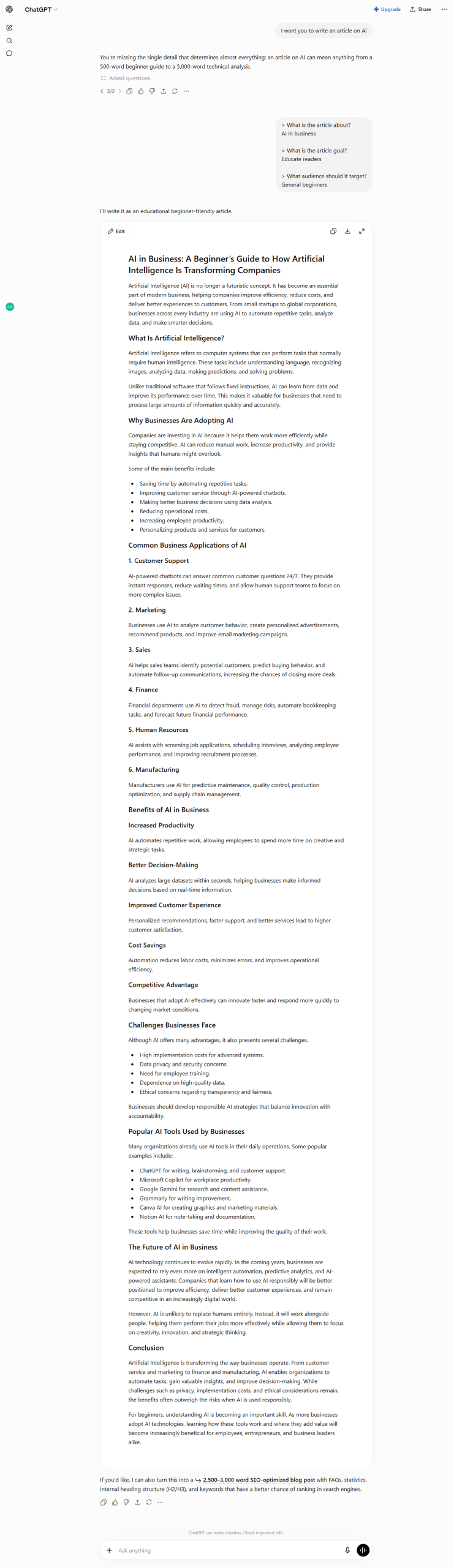
The more specific and detailed your prompt is, the better your result will be. This is true for every single AI tool. Give it context. Tell it what you actually need. Explain the situation. If you want a certain tone, say so. If there are things you don’t want included, mention that too.
I’ve tested this directly same task, two different prompts, one generic and one detailed. The difference in output quality is immediately obvious. The detailed prompt wins every single time, with every AI tool.
Your prompt is essentially how well you communicate with the AI. Communicate clearly, and the AI performs well. Communicate vaguely, and you’ll get vague results back.
How I Think About AI Tools Now
After this experiment and months of using all four tools regularly, my approach is completely different from when I started.
I think of them as specialists rather than competitors.
When I need to go deep on a document or piece of writing, I go to Claude. When I’m working through a technical problem or debugging code, I open ChatGPT. When I want to know what’s happening in the world right now or what people are actually talking about on social media, I check Grok. When I need something tied to recent web search results, Gemini helps.
None of them is the best tool. Each of them is the best tool for something specific.
If you’re only using one AI and wondering why you’re not getting great results consistently, try matching the tool to the task instead of forcing everything through the same door. You’ll notice the difference almost immediately.
What I’d Tell Someone Just Starting With AI

If you’re new to AI tools and trying to figure out where to start, here’s the simplest version of what I’ve learned:
Start with ChatGPT if you want something easy to navigate and good for general everyday questions. But don’t stop there. Spend some time with Claude if you’re doing writing or research. Try Grok when you want to know what’s happening right now. Experiment with Gemini for anything where recent web information matters.
More importantly learn to write better prompts. Whatever tool you’re using, your prompt is the most important variable. A great prompt with a good tool will consistently outperform a bad prompt with a great tool.
AI is genuinely useful. But how useful it is depends almost entirely on how you use it.
Have you ever tried giving the same prompt to multiple AI tools and comparing the results? If you haven’t, try it the differences might surprise you just as much as they surprised me. Drop your experience in the comments.